
Faceless YouTube · Channel ideas
Faceless YouTube channel ideas that work with animated characters
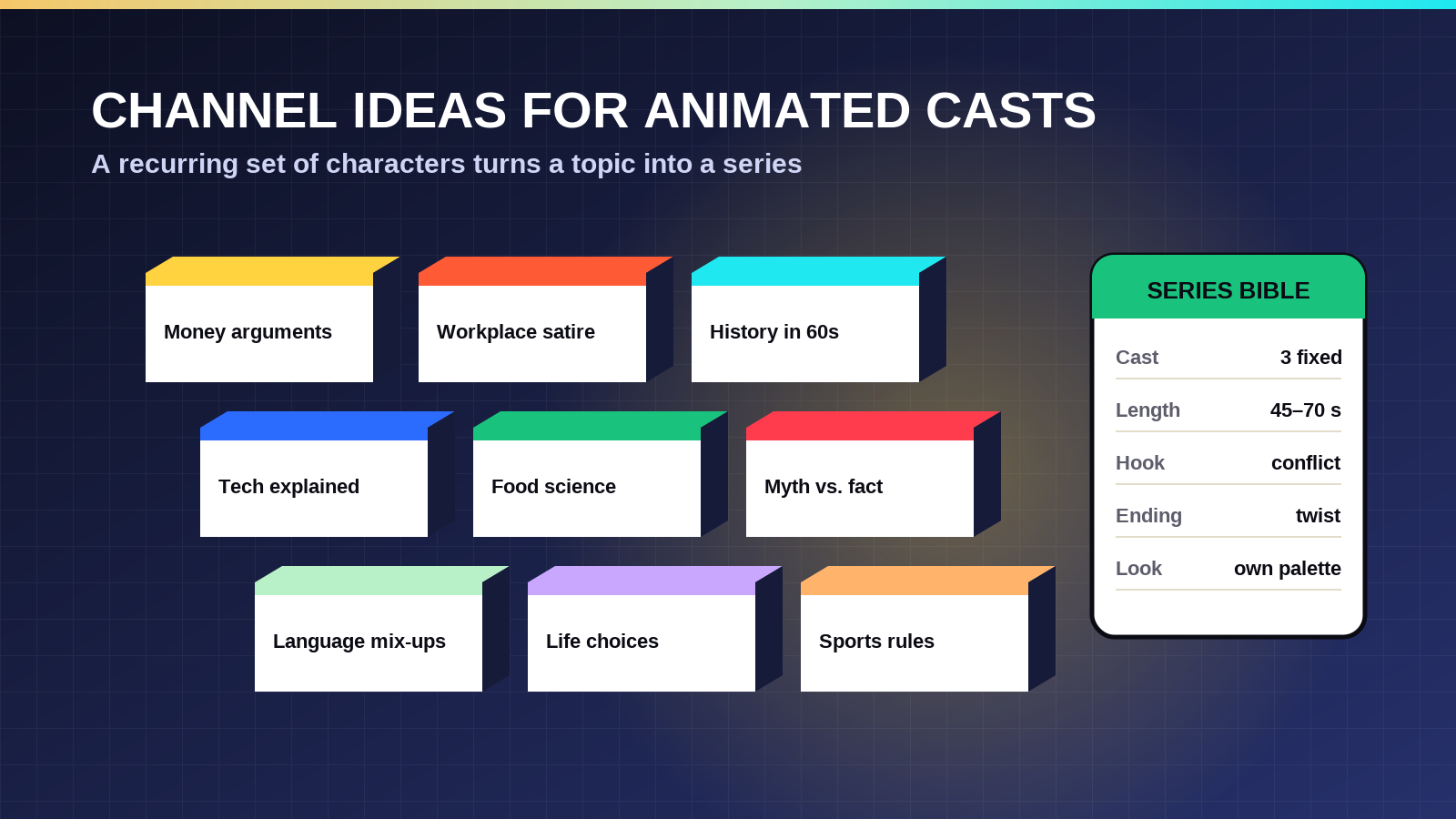
Most lists of faceless channel ideas are lists of topics: finance, history, true crime, facts. A topic is not a channel. What turns a topic into something people subscribe to is a format they recognize in one second, and the strongest faceless format there is happens to be a recurring cast of animated characters. Below are 12 ideas built that way, each with a cast and episode examples, plus a quick way to score any idea before you spend a week building it.
Why characters beat topics
A narrated topic video asks the viewer to care about information. A character video asks them to care about someone, and people come back for someone far more reliably than for information. Characters also solve three practical problems of faceless channels:
- Recognition. A viewer who has seen your skeptic and your optimist argue twice will recognize the third episode instantly in the feed. That recognition is the closest thing a faceless channel has to a face.
- Endless episodes. A topic runs out; a relationship doesn't. Two characters with opposite views on money can argue about a thousand purchases.
- Originality. A cast you designed, with its own voices and running jokes, is hard to copy and easy to tell apart, which is exactly what YouTube's rules on mass-produced content reward.
The setup cost is real: someone has to design the characters, sets and voices once. With an AI coding agent that work moves from "weeks of animation" to "a few sessions of describing what you want". After that, each episode is mostly writing. Our guide to AI animation for YouTube covers how that production side works.
12 channel ideas built around a cast
Each idea lists a cast and three episode examples, to show the format can repeat. They are starting points, not finished channels. Change the cast, the tone and the angle until it's yours.
1. The money argument
Cast: a spender and a saver who share an apartment. Episodes: "Is a $7 coffee every day really that bad?", "Leasing vs. buying, settled at the dinner table", "The saver finally buys something." Works as Shorts and stretches to longer explainers.
2. Office satire
Cast: a burned-out employee, an overexcited manager, an intern who knows everything. Episodes: the meeting that could have been an email, the reply-all disaster, the return-to-office announcement. Relatable, endlessly topical, advertiser-friendly if you keep it kind.
3. History in 60 seconds
Cast: a narrator character who time-travels and keeps making things worse. Episodes: famous inventions, strange laws, bad decisions by real rulers. Facts must be checked; the comedy comes from the narrator, not from distorting history.
4. Tech explained by two roommates
Cast: a confused roommate and a patient (or not) one. Episodes: why your phone gets slower, what "the cloud" actually is, why passwords need to be long. Strong search demand for "how does X work" questions.
5. Food science kitchen
Cast: a chef who cooks by instinct and a scientist who measures everything. Episodes: why you rest a steak, does salt really boil water faster, why bread goes stale. Safe for advertisers, easy to visualize.
6. Myth vs. fact court
Cast: a judge, a myth-defending lawyer, a fact-checking prosecutor. Episodes: "We only use 10% of our brains", "Goldfish have three-second memories", "Lightning never strikes twice." The verdict is the payoff of every episode.
7. Language mix-ups
Cast: a learner and a native speaker. Episodes: false friends, phrases that don't translate, idioms taken literally. Works in any language pair, and can be remade in several languages with the same animation.
8. Life choices, two timelines
Cast: one character in a split screen, living two versions of the same day. Episodes: phone at dinner vs. no phone, saving at 25 vs. 35, the gym in January vs. March. Strong visual hook; the split screen tells you the format in one frame.
9. Sports rules, finally explained
Cast: a lifelong fan and a total beginner. Episodes: offside, the cricket over, why baseball has so many stats. Rules are evergreen; tie episodes to big events for timely spikes.
10. The landlord and the tenant
Cast: a tenant who reads every clause and a landlord who hopes they won't. Episodes: security deposits, "normal wear and tear", the mystery fee. Practical value plus conflict. Keep legal statements general and point to official sources, because rules differ by place.
11. Small business survival
Cast: a first-time founder and a grumpy accountant. Episodes: pricing your first product, the customer who wants a refund after a year, why cash flow isn't profit. Business and money topics also tend to attract advertisers; see our notes on high-RPM faceless niches.
12. The overthinker
Cast: one character and their very loud inner voice. Episodes: replying to a text, choosing a restaurant, leaving a party. Short, relatable, built for loops and sharing.
Score an idea in five minutes
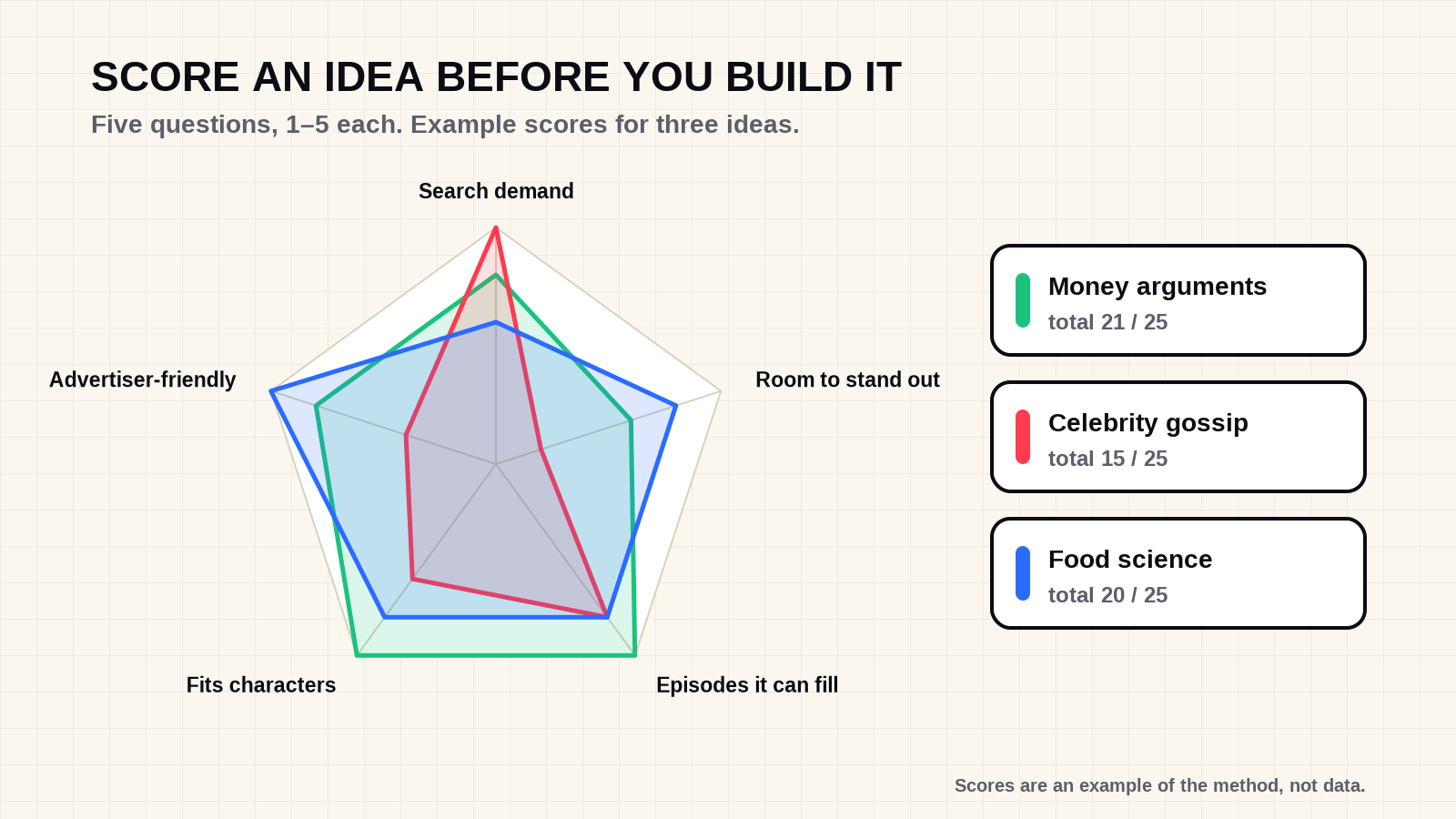
Before you design anything, give the idea a score from 1 to 5 on each of these five questions. Anything under about 17 out of 25 is worth reworking before you build.
| Question | How to check |
|---|---|
| Search demand: are people looking for this? | Search the topic on YouTube and read the autocomplete suggestions; check a keyword tool for volume and trend. |
| Room to stand out: can you look different? | Scroll the top 20 results. If they all look the same and yours would too, score low. |
| Episodes it can fill: 50 ideas, or 5? | Write 20 episode titles in ten minutes. If you stall at eight, the format is too narrow. |
| Fits characters: is there conflict between two points of view? | Can you describe the cast as "X vs. Y"? If not, a narrator format may suit it better. |
| Advertiser-friendly: could most brands sit next to it? | Read YouTube's advertiser-friendly content guidelines; violence, shock and heavy profanity limit ads. |
Notice: "celebrity gossip" scores high on demand and low on everything else. High demand alone is a trap: it usually means the space is crowded and the content is easy to copy.
A cast you can reuse every episode
The Starter kit includes a code-based character engine: change outfits, colors and sets to build your own cast, then let Claude Code animate new episodes from a script.
See the Starter kit, $19One-time payment. Requires Claude Pro ($20/month).
Design the cast once
The work that makes a character channel scale is done before episode one. Write a one-page "series bible" for the cast and give it to whoever (or whatever) writes your scripts. Every episode follows it, so the characters stay the same person week after week.
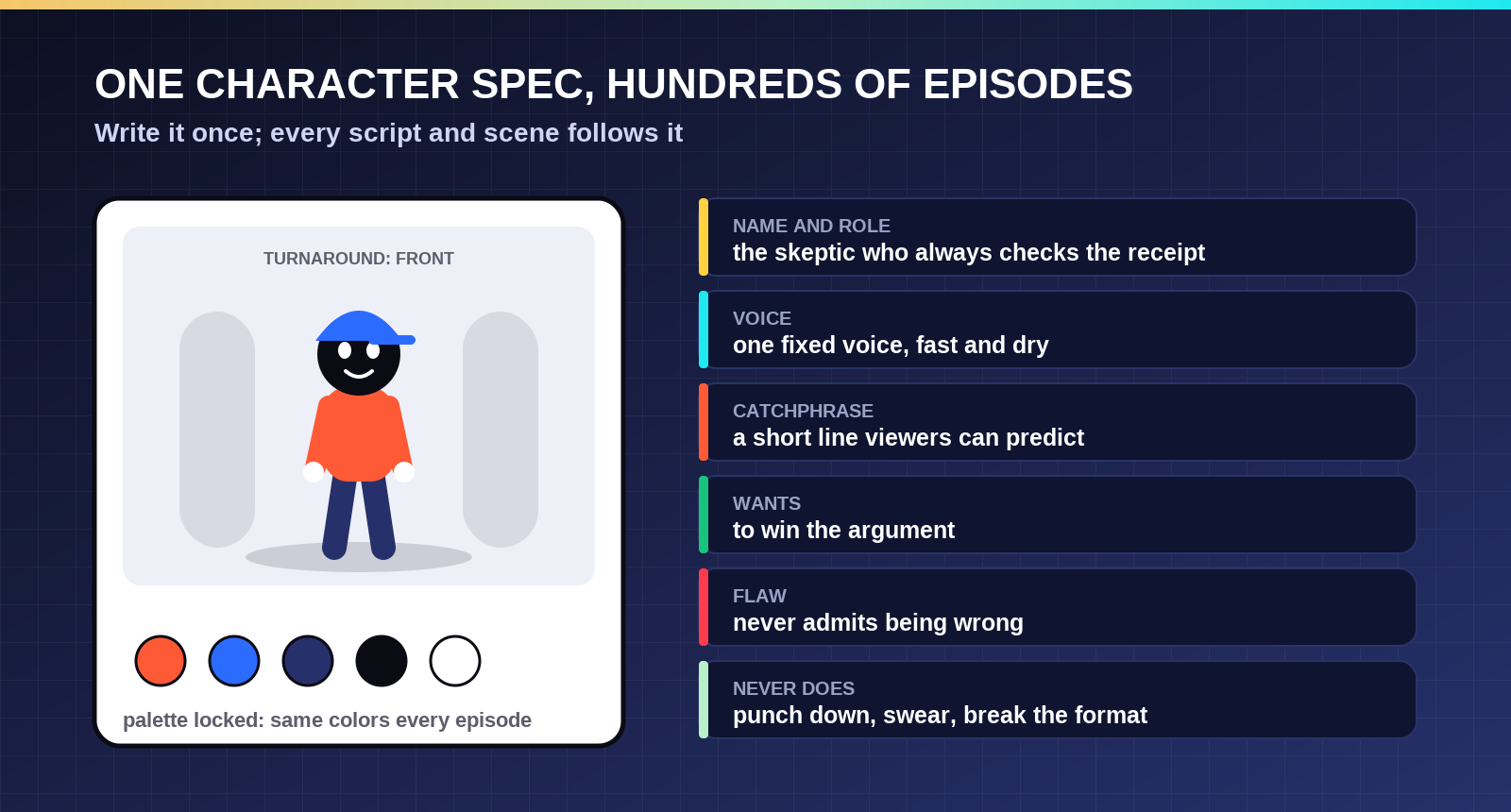
For each character, define:
- Look: a silhouette and a locked palette. Two characters should be tellable apart from their colors alone, at thumbnail size.
- Voice: one fixed voice, with notes on pace and tone.
- Want and flaw: what they're after in every scene, and what always gets in their way. Most jokes come from the flaw.
- Never-does list: the lines the character won't cross. This protects the tone of the channel when AI drafts scripts.
Then define the episode shape: length, how it opens (usually mid-conflict), the twist, and how it ends. With the bible and the shape fixed, writing an episode becomes a matter of picking a situation and letting the characters react, which is also where an AI assistant becomes a useful co-writer instead of a source of generic filler.
Animated doesn't mean "for kids"
Every channel must tell YouTube whether its videos are "made for kids". YouTube's Help Center lists animated characters as one of the factors to weigh, alongside the subject, the language, the intended and actual audience, and more. No single factor decides it, but a cartoon look means you should think about it deliberately rather than assume.
If your audience is adults (office satire, money, landlords), write like it: adult topics, adult references, no kid-oriented songs or activities. If you really are making content for children, set it as made for kids; personalized ads and some features such as comments are then restricted. YouTube also says creators shouldn't rely on its automatic detection, so this setting is your responsibility. When in doubt, read YouTube's "Determining if your content is made for kids" page.
Ideas to avoid
- Fan animations of famous characters. Someone else owns them, and YouTube has a separate policy on well-known children's characters placed in inappropriate situations.
- Real people saying fake things, realistically. Realistic synthetic depictions of real people need disclosure and can cross into misleading content. Satire of public figures needs to be obviously satire.
- Template swaps. The same scene with a different noun each day is the "interchangeable" content YouTube won't monetize. The cast should react differently because the situation is different.
- A cast with no conflict. Two characters who agree have nothing to say. Give them opposing wants.
Once you've picked an idea, our step-by-step guide to starting a faceless YouTube channel takes you from bible to first upload, and Claude AI YouTube automation shows how we turn scripts into animated episodes. Free helpers are on the tools page.
FAQ
What is a good faceless YouTube channel idea for beginners?
Pick a topic with steady search demand and build it around two characters with opposite points of view, like a spender and a saver. A recurring cast makes episodes easy to write and makes your channel recognizable without showing your face.
Do animated faceless channels get monetized?
Yes, animated channels can join the YouTube Partner Program like any other channel. What YouTube does not monetize is mass-produced or repetitive content, so each episode needs its own situation and story.
Will YouTube treat my cartoon channel as made for kids?
Not automatically. Animated characters are one factor among several, including subject, language and intended audience. You must set the audience yourself; if your content targets adults, make that clear in the topics and writing.
How many characters should a faceless channel have?
Two or three is a good start. Two characters with opposing wants create conflict in every episode; a third can break ties or add a running joke. More than that is harder to keep consistent.
Can I use famous cartoon characters on my channel?
No. Characters from films, shows and games are owned by someone else, and using them risks copyright claims and policy violations. Design your own cast.
Pick an idea, build the cast, ship episode one
The Starter gives you the engine, the blueprint and the prompts to turn one of these ideas into a series this week.
See the Starter kit, $19One-time payment. Requires Claude Pro ($20/month).