
Monetization · YouTube Shorts
YouTube Shorts monetization in 2026: requirements, revenue sharing and real expectations
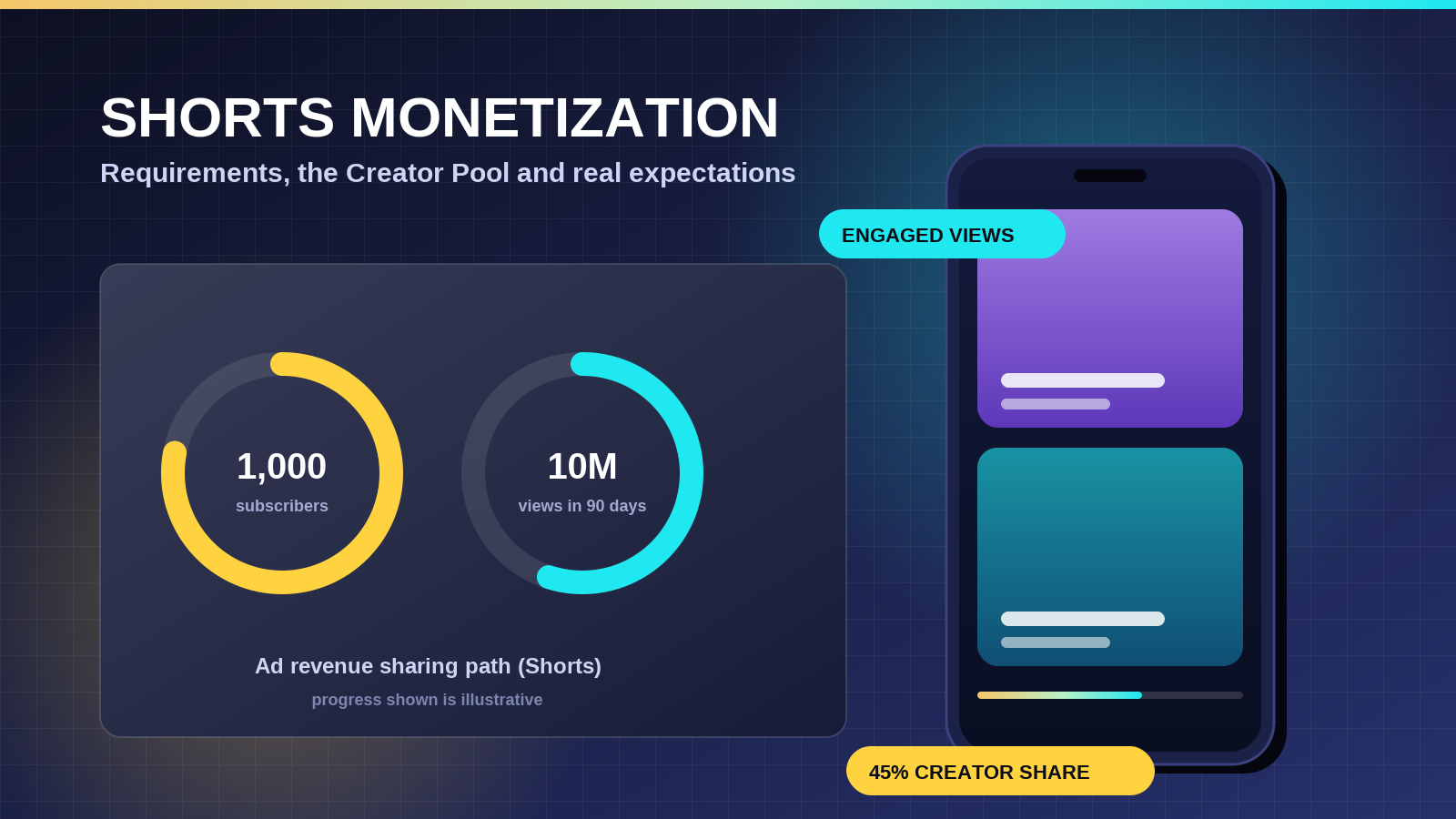
Shorts can get a new channel millions of views in a few weeks, which makes the money question urgent: when do you get paid, how much, and what can take it away? Here are the rules as YouTube Help states them in November 2026, how the Shorts revenue pool is actually split, a change already announced for February 2027, and the expectations we think are honest for a faceless channel.
The numbers, in one table
These are the thresholds published on YouTube Help, checked on November 26, 2026. They apply in countries where the Partner Program is available, and YouTube can change them, so treat this as a snapshot and re-check the official pages before you plan a launch.
| Tier | Subscribers | Plus one of these | What it unlocks |
|---|---|---|---|
| Expanded YPP | 500 | 3 public uploads in 90 days and 3,000 watch hours in 12 months, or 3 million Shorts views in 90 days | Fan funding (memberships, Super Thanks and similar) and Shopping |
| Full YPP | 1,000 | 4,000 public watch hours in 12 months, or 10 million Shorts views in 90 days | Ad revenue sharing on long-form and Shorts, plus everything above |
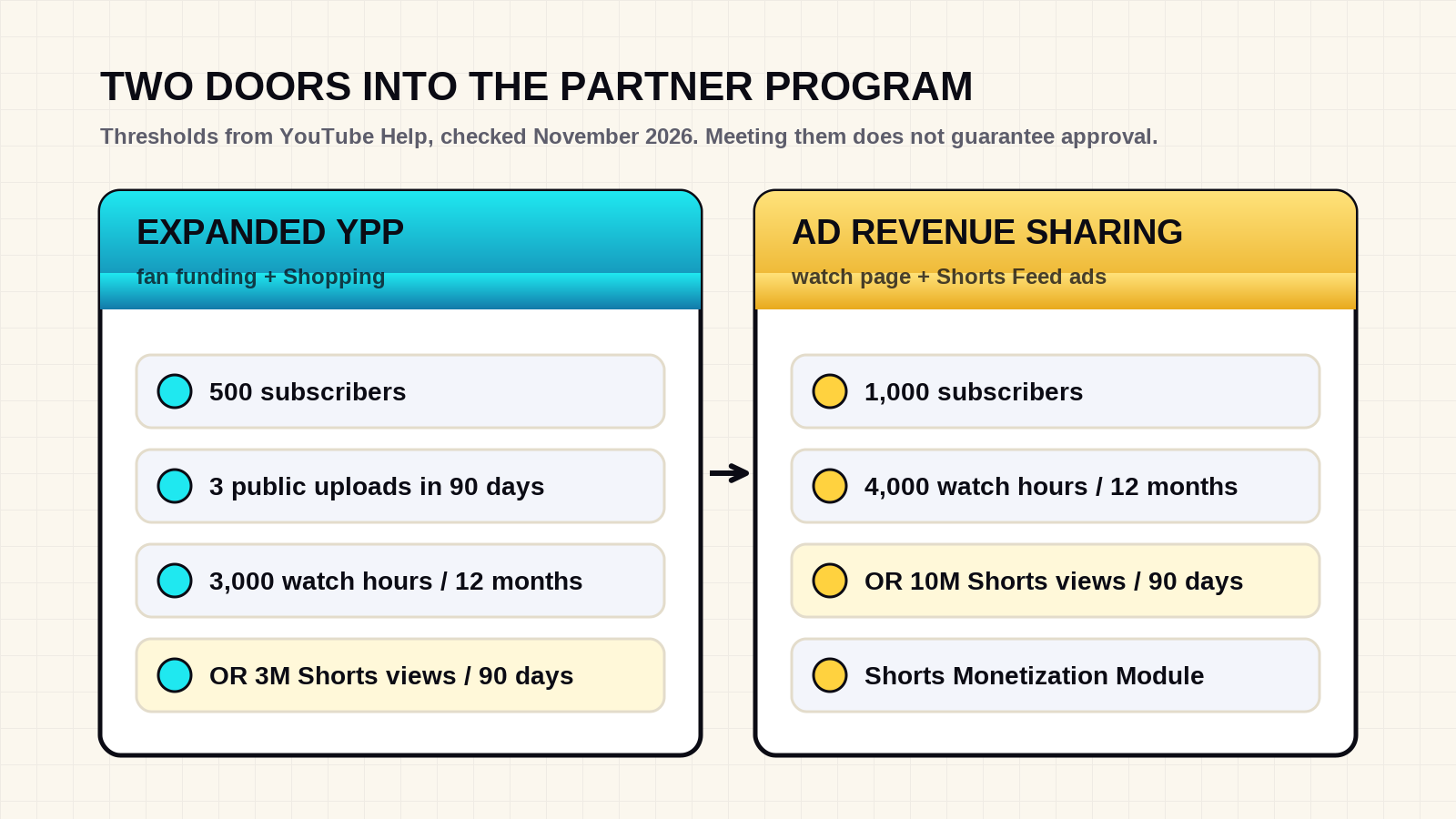
Meeting a threshold is not approval. YouTube reviews the channel before admitting it, and it checks content against its monetization policies. Hitting 10 million views with re-uploads or templated clips is a fast way to get rejected.
Two doors into the Partner Program
Most creators think there is one finish line. There are two, and they reward different things.
Door 1: the expanded program (500 subscribers)
This tier exists so smaller creators can earn from fans before ads. You get access to features like channel memberships, Super Thanks (which also works on Shorts) and YouTube Shopping. For a faceless channel with a loyal niche audience this can be worth more than you expect, because a viewer who chooses to tip is worth far more than an ad impression.
Door 2: ad revenue sharing (1,000 subscribers)
This is the one people mean by "monetized". You can qualify through long-form watch hours or through Shorts views, and you can mix formats on the same channel. One detail trips people up: watch time from Shorts played in the Shorts feed does not count toward the 4,000-hour path. Shorts count only through the Shorts-views path.
To be paid on Shorts specifically, you also need to accept the Shorts Monetization Module in YouTube Studio. Only views after you accept it count toward your share.
What counts as a Shorts view
Two different counters matter, and they are not the same as the big number under your video.
- Qualified Shorts views (for eligibility): views of public Shorts in the Shorts feed. Private, unlisted and deleted Shorts don't count.
- Engaged views (for payment): YouTube's paid-view metric. It excludes views it considers ineligible, such as views of non-original Shorts (for example unedited clips of someone else's content), artificial traffic, and views on content that isn't advertiser-friendly.
In practice this means a channel built on clipped movies, TV or other creators' videos can show huge view counts and still earn little or nothing from the pool. Original stories, explainers and animation sit on the right side of this line.
How Shorts revenue sharing works
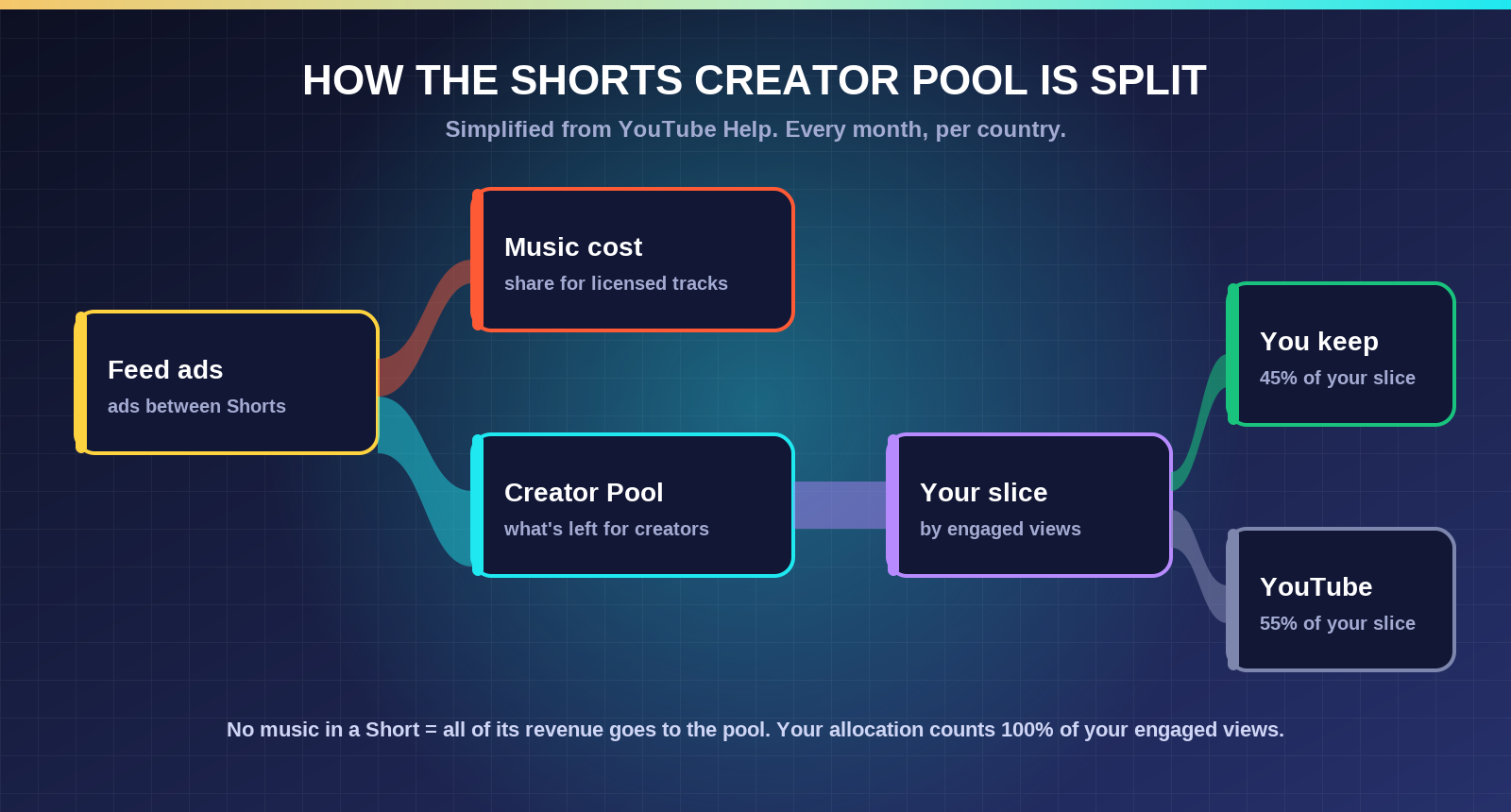
Shorts ads don't run on your individual video. They play between Shorts in the feed, so YouTube can't pay you per ad like on long-form. Instead it pools the money. Simplified from YouTube Help, every month and per country:
- Ad revenue from the Shorts feed is added up.
- Music is paid for. For revenue tied to Shorts that used licensed music, part goes to music partners: half for one track, two thirds for two tracks. Shorts without music send all their revenue to the pool.
- The rest becomes the Creator Pool.
- The pool is divided by engaged views. Your allocation is your share of all engaged views from monetizing creators in that country. Your music use doesn't shrink your view count here.
- You keep 45% of your allocation. The same 45% applies to Shorts revenue from YouTube Premium.
YouTube's help page walks through a hypothetical: $100,000 of feed ad revenue, 20% of Shorts with one music track, so $90,000 lands in the pool. A creator with 1 million of the 100 million engaged views gets 1% ($900) and keeps 45% of it, $405.
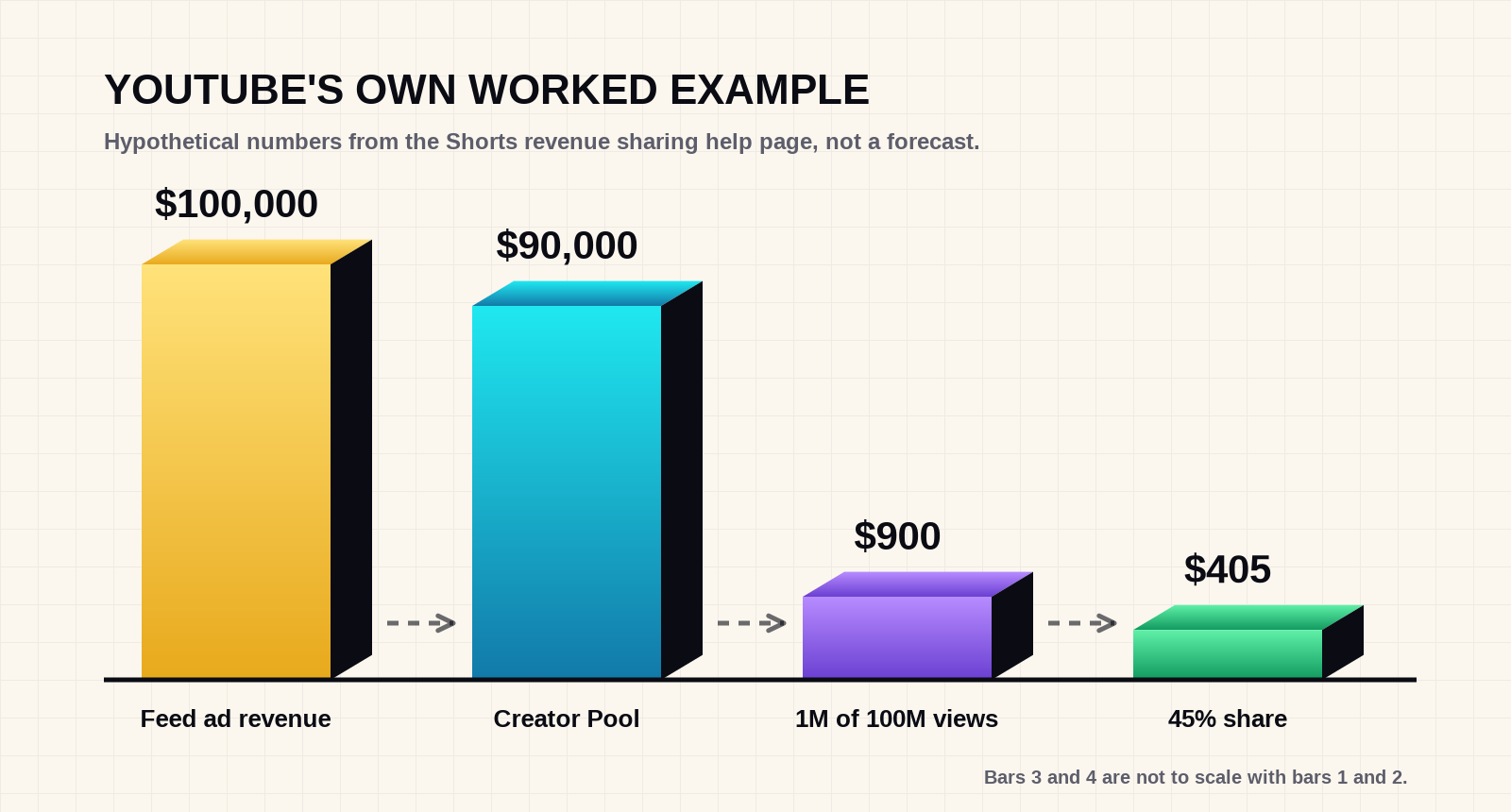
Don't read that example as "$405 per million views". The revenue, total views and music mix are made-up inputs. Real results depend on your viewers' countries and on how much advertisers spend in a given month.
Making Shorts is the easy part to automate
The Starter is the setup we use to write, voice, animate and cloud-render faceless Shorts with Claude Code, so your time goes into ideas and packaging instead of editing.
See the Starter kit, $19One-time payment. Requires Claude Pro ($20/month).
The February 2027 change
YouTube's Shorts revenue sharing help page lists two changes starting February 1, 2027:
- To earn a share of Shorts ad revenue from the Creator Pool, a channel will need at least 10 million qualified Shorts views in the last 90 days. Read literally, Shorts pool revenue is tied to keeping that level of views, not just to reaching it once to join.
- Shorts ads targeted to small groups of 5 or fewer channels will pay those channels directly, with creators keeping 45% of the net ad revenue.
At the time of writing, the general Partner Program overview page still lists only the current thresholds and doesn't mention 2027. If your plan depends on Shorts pool revenue, read both pages yourself and watch YouTube's official creator channels for clarifications. Our takeaway: a channel that lives only on Shorts pool money is fragile. Build a second income path (below) from the start.
Real expectations
Here is the honest version, without income promises:
- Shorts pay much less per view than long-form. Creators who publish their Studio numbers commonly report Shorts RPMs measured in cents per 1,000 views, while long-form RPMs are usually measured in dollars. Your numbers can sit outside any range you read online.
- Geography matters more than the niche label. The pool is split per country, so the same million views from different countries can pay very differently.
- 10 million views in 90 days is a lot. That is roughly 110,000 qualified views a day for three months. Many channels reach 1,000 subscribers long before they reach it.
Some quick, purely illustrative arithmetic: if a channel kept exactly 10 million engaged views in 90 days and its effective Shorts RPM landed somewhere between $0.02 and $0.10, that would be $200 to $1,000 for the quarter. Those RPM bounds are assumptions for the math, not a forecast. The point is the order of magnitude: Shorts are mostly a discovery engine, and the money tends to come from what viewers do next.
What gets Shorts demonetized
The biggest risk for automated and faceless channels is not a threshold. It's policy.
- Inauthentic content. In July 2025 YouTube renamed its "repetitious content" rule to "inauthentic content". It covers videos that look made from a template with little variation, or that are easily replicable at scale, including AI-made videos that add no original perspective. Violations can remove monetization from the whole channel.
- Reused content. Compilations and clips of other people's work without meaningful commentary or transformation.
- Claimed content in longer Shorts. Shorts can be up to three minutes, and those uploaded after October 15, 2024 can join revenue sharing, but Shorts over one minute with an active Content ID claim are blocked from monetization.
- Advertiser-unfriendly topics. Views on content that fails the advertiser-friendly guidelines don't count as engaged views.
Automation is fine. Sameness isn't. A series with a consistent cast and look is a format; fifty Shorts with the same narration over different stock clips is a template. Our guide to Claude AI YouTube automation covers how we keep every video its own story while reusing the engine.
Making Shorts pay beyond the pool
- Use Shorts as a funnel. Link a Short to a related long video. Long-form has ads on your own video, and mid-roll ads on videos of 8 minutes or more.
- Turn on fan funding early. Super Thanks on Shorts and memberships need only the 500-subscriber tier.
- Sell or recommend things that fit the niche. Shopping and honest affiliate links can outearn the pool in some niches. Disclose them clearly.
- Pick a niche where advertisers spend. We compare niches, with real ranges and their caveats, in high-RPM faceless niches.
If you're still finding your audience, start with how to grow on YouTube from zero, and if you already post vertical videos on Instagram or TikTok, our free downloader saves your own clips without a watermark so you can repurpose them as Shorts.
A checklist before you apply
- Your channel is mostly original: your scripts, your visuals, your voice or a licensed one.
- No unedited re-uploads, and no long Shorts with Content ID claims.
- Two-step verification is on for your Google account (YouTube requires it to apply).
- You have an AdSense account you can link, in your own name.
- You've read the YouTube monetization policies and the Shorts revenue sharing terms, not a summary of them.
- You know which income path you'll grow besides the Shorts pool.
FAQ
How many views do you need to monetize YouTube Shorts?
For ad revenue sharing, YouTube asks for 1,000 subscribers plus 10 million qualified public Shorts views in the last 90 days (or 4,000 public watch hours in 12 months). A lower tier at 500 subscribers and 3 million Shorts views in 90 days unlocks fan funding and Shopping, not ad revenue.
How much does YouTube pay per 1,000 Shorts views?
There is no fixed rate. Your Shorts RPM depends on the ad revenue in your viewers' countries, your share of engaged views and whether you used music. Creators who share their numbers commonly report Shorts RPMs measured in cents per 1,000 views, far below long-form.
Do Shorts with music earn less?
The revenue tied to a Short with licensed music is split with music partners before it reaches the Creator Pool, but your allocation from the pool counts all of your engaged views, with or without music. You keep 45% of your allocation either way.
Can a faceless or AI-assisted channel monetize Shorts?
Yes, if the content is original and not mass-produced. YouTube's inauthentic content policy targets templated, repetitive videos with little variation. Views from non-original Shorts, such as unedited re-uploads, are excluded from revenue sharing.
Does the 10 million views rule change in 2027?
YouTube's Shorts revenue sharing help page says that starting February 1, 2027, earning a share of Shorts ad revenue from the Creator Pool requires at least 10 million qualified Shorts views in the last 90 days. Read that page for the exact wording before you plan around it.
Build the format first, the money follows the format
Get the engine, the blueprint and the prompts we use for our own faceless Shorts, and make your first one this week.
See the Starter kit, $19One-time payment. Requires Claude Pro ($20/month).