
Niches · Monetization
High-RPM faceless niches: where animated channels make sense
"Pick a high-RPM niche" is the most repeated advice in faceless YouTube, usually followed by a table promising finance channels $20 or more per 1,000 views. Reality is messier. RPM depends on who watches, where they live, how long the video is and whether advertisers want to be next to it. This guide looks at what the published numbers actually say, why they disagree, and in which niches animation earns its place.
RPM vs CPM in one minute
- CPM is what advertisers pay per 1,000 ad impressions, before YouTube's share. It's an advertiser number.
- RPM is what you earn per 1,000 views, after YouTube's share, counting all views (including those that showed no ad) and other revenue like memberships or Premium.
When someone says "finance has a $30 CPM", that does not mean you earn $30 per 1,000 views. RPM is the number that matters for planning, and it's always lower than CPM.
What the published ranges say
Search "YouTube RPM by niche" and you'll find dozens of tables. They agree on the order (finance, business and education near the top; gaming and kids near the bottom) and disagree wildly on the numbers. Two examples, both published in 2026:
- A creator-tool vendor's benchmarks list personal finance and investing at roughly $5–17 RPM, insurance $7–17, legal $5–15 and real estate $5–13.
- An agency dataset of 300 channels it works with, using YouTube Studio data from May 2025 to May 2026, reported much lower medians for most niches. It found Education & Science at a median of $10.22, while Business & Finance came in at $2.01, though that group had fewer than ten channels.
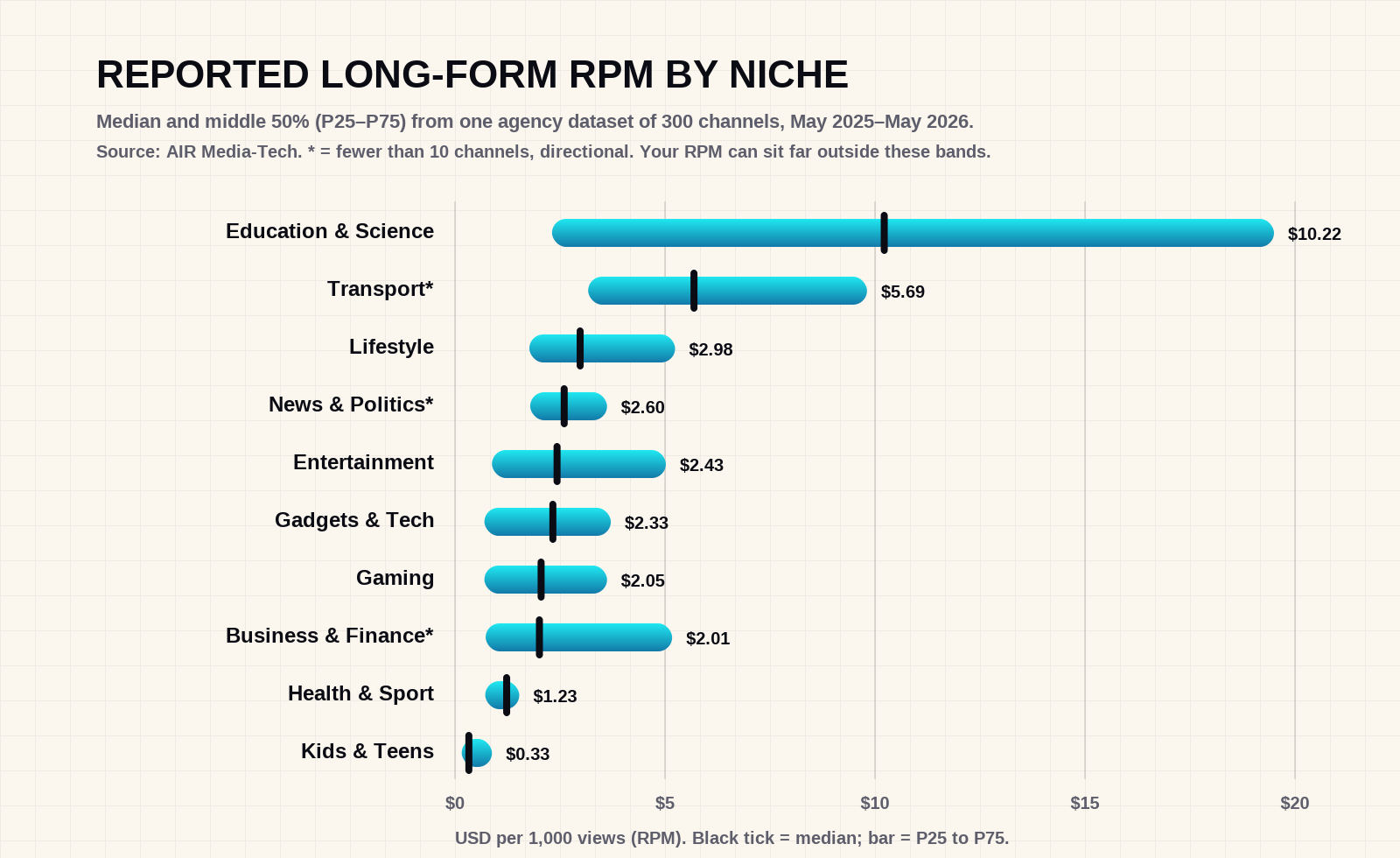
Neither source is "wrong". Vendor tables often describe what top channels in a niche can reach, aimed at US audiences. Agency data describes what a mix of real channels actually got, with viewers from everywhere. The gap between them is the lesson: a niche label sets the ceiling, not your number.
Be careful with RPM claims from people selling a course about that niche. The numbers may be real for their channel and still be irrelevant for yours. Nobody can promise you an RPM.
What moves RPM more than the niche
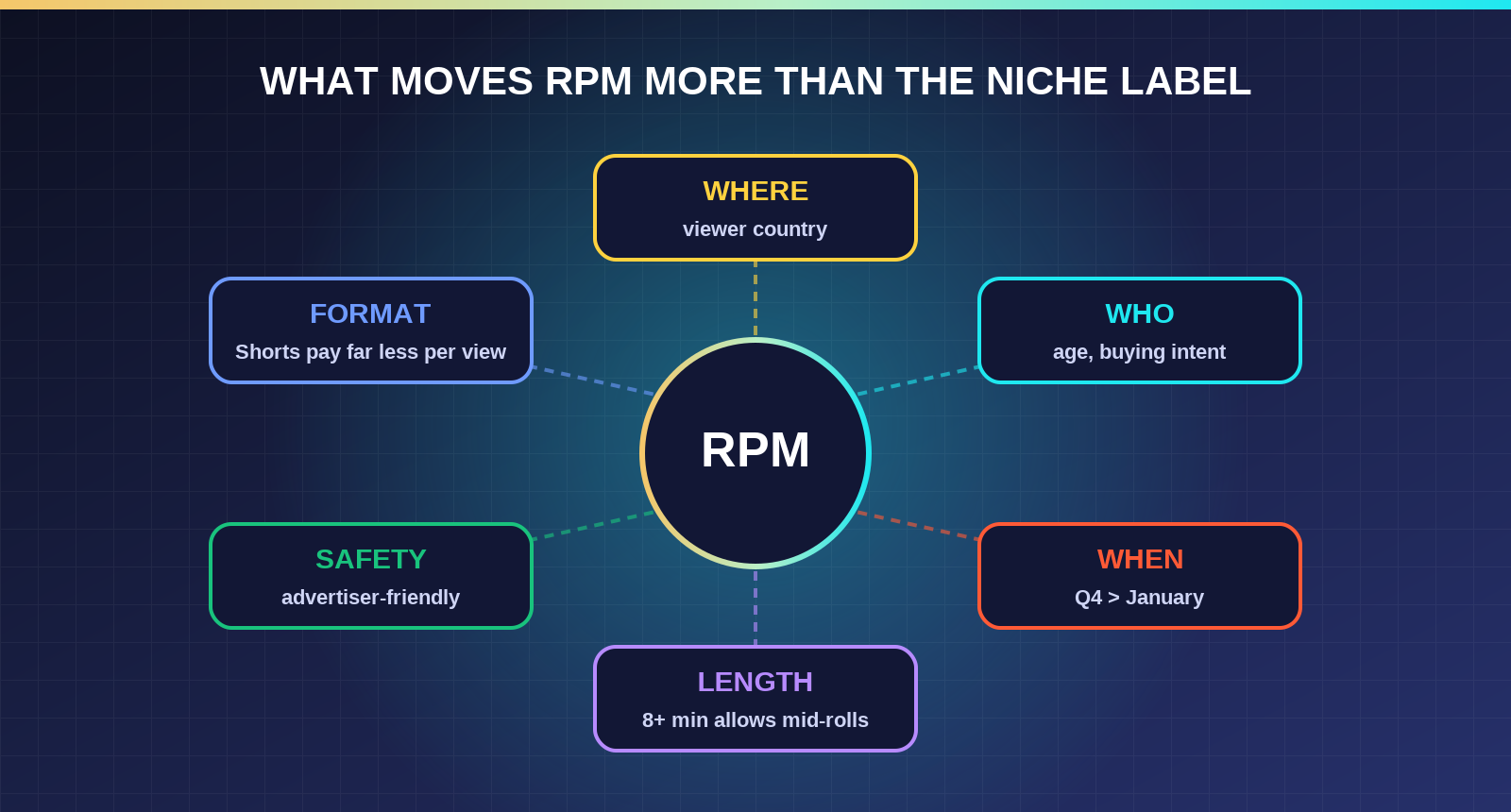
- Where viewers live. Advertisers pay very different prices in different countries. The same video can earn several times more from one audience than another.
- Who they are. Adults with buying intent (people researching a loan, software or a car) are worth more to advertisers than casual entertainment viewers.
- When. Ad spend tends to rise toward the end of the year and drop in January. Your RPM will move with the calendar even if nothing changes on your channel.
- Length. On YouTube, mid-roll ads are available on videos of 8 minutes or longer. A 10-minute explainer has more ad slots than a 4-minute one.
- Advertiser safety. Topics that fail the advertiser-friendly guidelines get limited or no ads. Crime, tragedy and controversy can get views and still pay little.
- Format. Shorts revenue comes from a shared pool and is typically much lower per view than long-form. More on that in our Shorts monetization guide.
A high-RPM niche still needs videos people finish
The Starter is how we produce animated explainers and story videos with Claude Code: script, voices, animation and cloud render, so you can test a niche with real episodes, not guesses.
See the Starter kit, $19One-time payment. Requires Claude Pro ($20/month).
Where animation earns its place
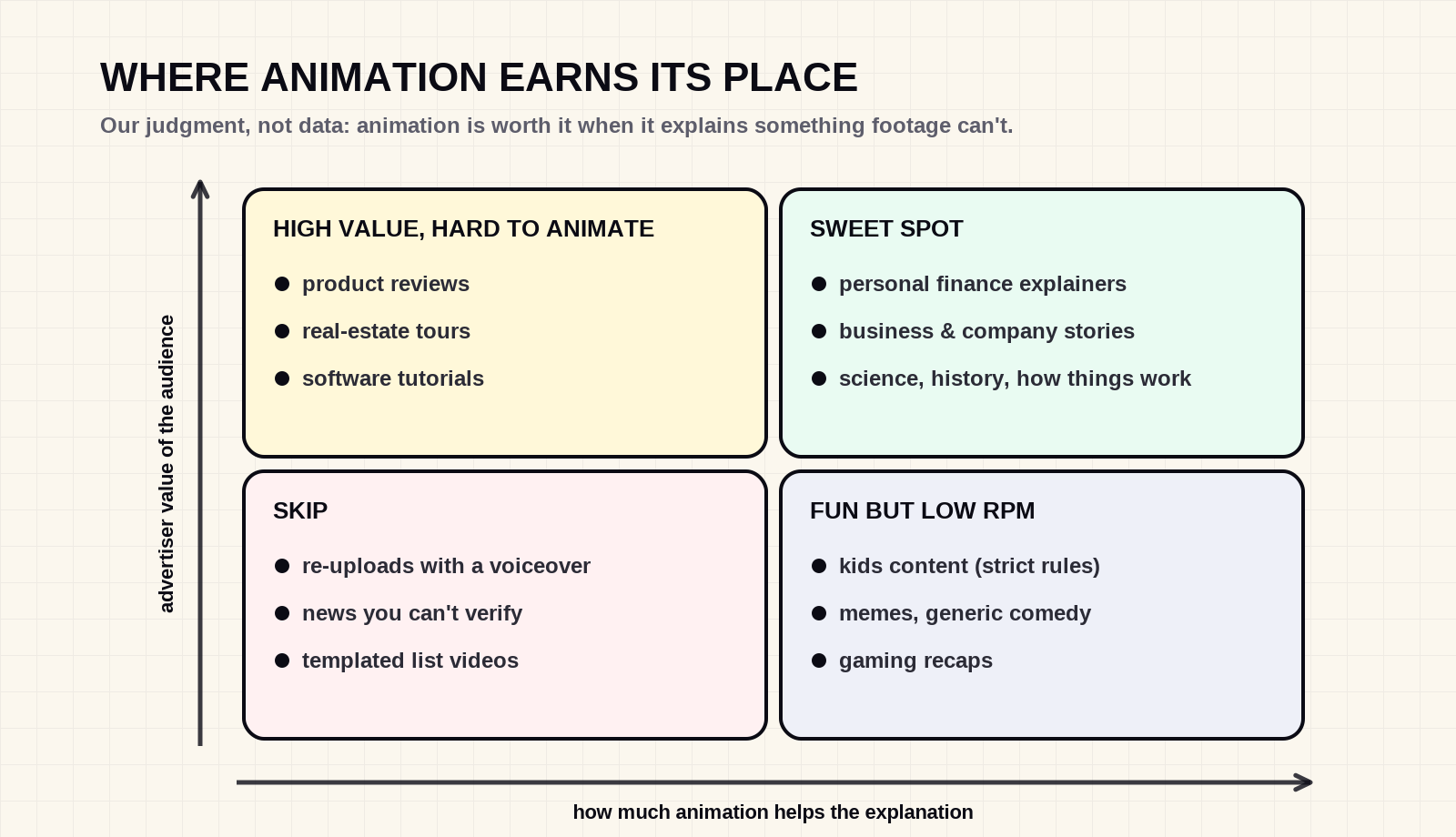
A faceless animated channel has one big advantage: it can show things a camera can't. Compound interest, a company's rise and fall, how a jet engine works, a negotiation that happened behind closed doors. It has one big cost: every second has to be made. So the question isn't "which niche pays most?" but "where does animation make the video clearly better?"
Niche by niche
| Niche | Advertiser interest | Animation fit | Watch out for |
|---|---|---|---|
| Personal finance explainers | High (reported) | Strong: concepts, comparisons, characters arguing about money | Don't give personalized advice; be careful with investment claims |
| Business and company stories | Medium to high | Strong: founders, deals and turning points as scenes | Facts must be checked; no real logos or invented quotes |
| Science, history, how things work | Medium to high (Education ranked first in the agency data) | Strong: the classic animated explainer | Research time; accuracy matters more than speed |
| Tech and software explained | Medium to high | Good for concepts; weak for tutorials, where viewers want the real screen | Tools change fast, so videos date quickly |
| Health and wellness | High for some topics | Good for how the body works | Medical claims need sources; misinformation policies are strict |
| Insurance, legal, real estate | High (reported) | Medium: animation helps explain, but the audience is narrow | Rules vary by country; keep it educational, not advice |
| Kids and family | Low per view | Strong visually | Made-for-kids rules: no personalized ads, limited features |
| Gaming recaps, memes | Low to medium | Possible, but footage often does it better | Reused-content and copyright risk |
The pattern: animation is worth the effort in niches where the idea is the product (money, business, science, history) and the audience is adults with intent. For ideas, see faceless YouTube channel ideas; for the production side, AI animation for YouTube.
Three formats that fit
A niche is not a channel. Here are three animated formats in higher-value niches, described as formats so you can see what repeats from episode to episode and what changes.
1. "The money argument" (personal finance)
Two recurring characters disagree about a money decision: rent or buy, pay off debt or invest, new car or used. Each episode ends on one real, sourced number that settles it, or shows it depends. The cast and the structure repeat; the decision and the data change. It works as a 45-second Short and as an 8–12 minute long video with several rounds.
2. "How they actually made money" (business stories)
Each episode takes one company or founder and tells the story through three or four turning points, drawn as scenes rather than stock footage. The risk is accuracy, so every claim needs a source and invented dialogue needs to be clearly framed as dramatization. Real logos and trademarks stay out of the frame.
3. "What happens inside" (science and how things work)
One object or process per episode (a credit card payment, a jet engine, a vaccine trial) followed from start to finish, with the camera going places a real camera can't. Evergreen topics keep earning views long after upload, which matters more than a high RPM on a video nobody finds after a week.
What these three share: an adult audience with intent, a structure you can repeat 50 times without it becoming a template, and a reason the animation exists. That last point is also what keeps you on the right side of YouTube's inauthentic content policy.
How to sanity-check a niche before committing
- Find five channels like the one you want to build. Look at their video lengths, how often they post and how old they are. If none of them is small and growing, the niche may be closed to newcomers.
- Look at the ads. Watch a few videos in the niche from your target country. Are advertisers there, and are they the kind who pay well (software, finance, education)?
- Check advertiser-friendliness. Read YouTube's advertiser-friendly guidelines with your 30 episode ideas in hand. Cut the ones that would likely get limited ads.
- List 30 episodes. If you can't, the niche is too narrow for a format.
- Make three pilots and publish them. Your own retention and click-through numbers beat any RPM table.
- Estimate time per episode. A high-RPM niche that takes 40 hours per video can earn less per hour than a medium one you can make in four. Automating the repetitive parts (voices, render, captions) is where tools like Claude Code help.
A note on Shorts
Almost every RPM table you'll see is about long-form. Shorts are paid from a shared Creator Pool split by engaged views, so the niche matters less and the per-view number is typically far lower. That doesn't make Shorts useless in a high-RPM niche: they're a cheap way to test ideas and send viewers to the long videos where the RPM actually lives. If you repurpose clips from Instagram or TikTok, our free downloader saves your own videos without a watermark.
FAQ
What is the highest RPM niche on YouTube?
Published tables usually put personal finance, insurance, legal, real estate, business and some health topics at the top, because advertisers pay more to reach those viewers. But independent data shows wide spreads inside each niche, and audience country often matters more than the topic.
What is a good RPM for a faceless channel?
There's no universal good number. One agency dataset of 300 channels reported an all-niche median RPM around $2.30 for long-form between May 2025 and May 2026. Compare your RPM with your own history and your niche, not with screenshots online.
Why is my RPM lower than the numbers I see online?
Common reasons: many viewers from lower-ad-spend countries, short videos without mid-rolls, Shorts views (which pay much less per view), limited ads on some videos, or a younger audience. Many published tables also come from sellers of courses or tools.
Are animated channels good for high-RPM niches?
Often, yes, when animation explains something footage can't: money concepts, company stories, how things work, history. It's a weaker fit where viewers want to see the real thing, like product reviews or property tours.
Is the kids niche good for animated channels?
It's a common animation niche but usually a low-RPM one. Videos set as made for kids don't get personalized ads and lose some features, and they come with strict rules. One dataset reported a median RPM around $0.33 for Kids and Teens.
Pick the niche, then build the format
Get the engine, the blueprint and the prompts we use for our own animated channels, and make your first episode this week.
See the Starter kit, $19One-time payment. Requires Claude Pro ($20/month).