
Growth · Faceless YouTube
How to grow on YouTube from zero: a faceless creator's playbook
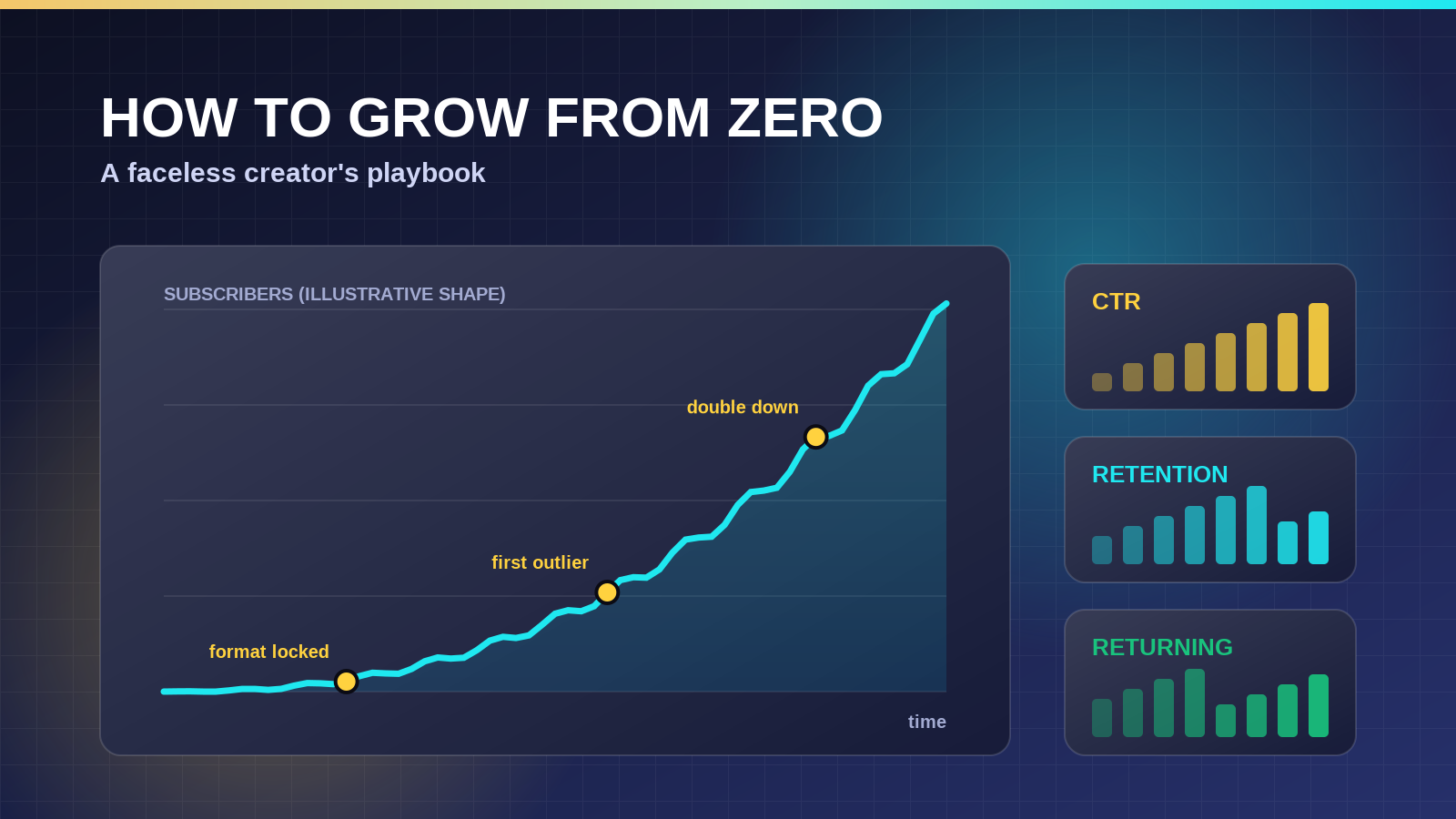
If you search "how to grow on YouTube" you get the same advice: be consistent, make good thumbnails, engage with comments. It's true and it's useless, because it doesn't tell you what to do on Monday. This playbook is for faceless creators starting at zero subscribers. When you don't have a face, your format has to do the work a face does: be recognizable, be trusted, and make people come back.
Your format is your face
A face gives viewers three things: they recognize you in the feed, they trust you, and they want to see what you do next. A faceless channel has to give them the same three through its format. A format is not a topic. "Personal finance" is a topic. "A 45-second argument between a saver and a spender, settled by one real number" is a format.
Write a one-page format card before you make anything:
- Promise: what a viewer gets from every episode, in one sentence.
- Shape: hook, middle, payoff, and how long each part runs.
- Look: palette, type, characters or visual motif. Something people recognize at thumbnail size.
- Voice: narrator, characters, or text only. Same voice every episode.
- Episode list: at least 30 ideas that fit. If you can't list 30, the format is too narrow.
Not sure where to start? We collected options in faceless YouTube channel ideas, and the niches where animation earns its place in high-RPM faceless niches.
Find proven demand before you make anything
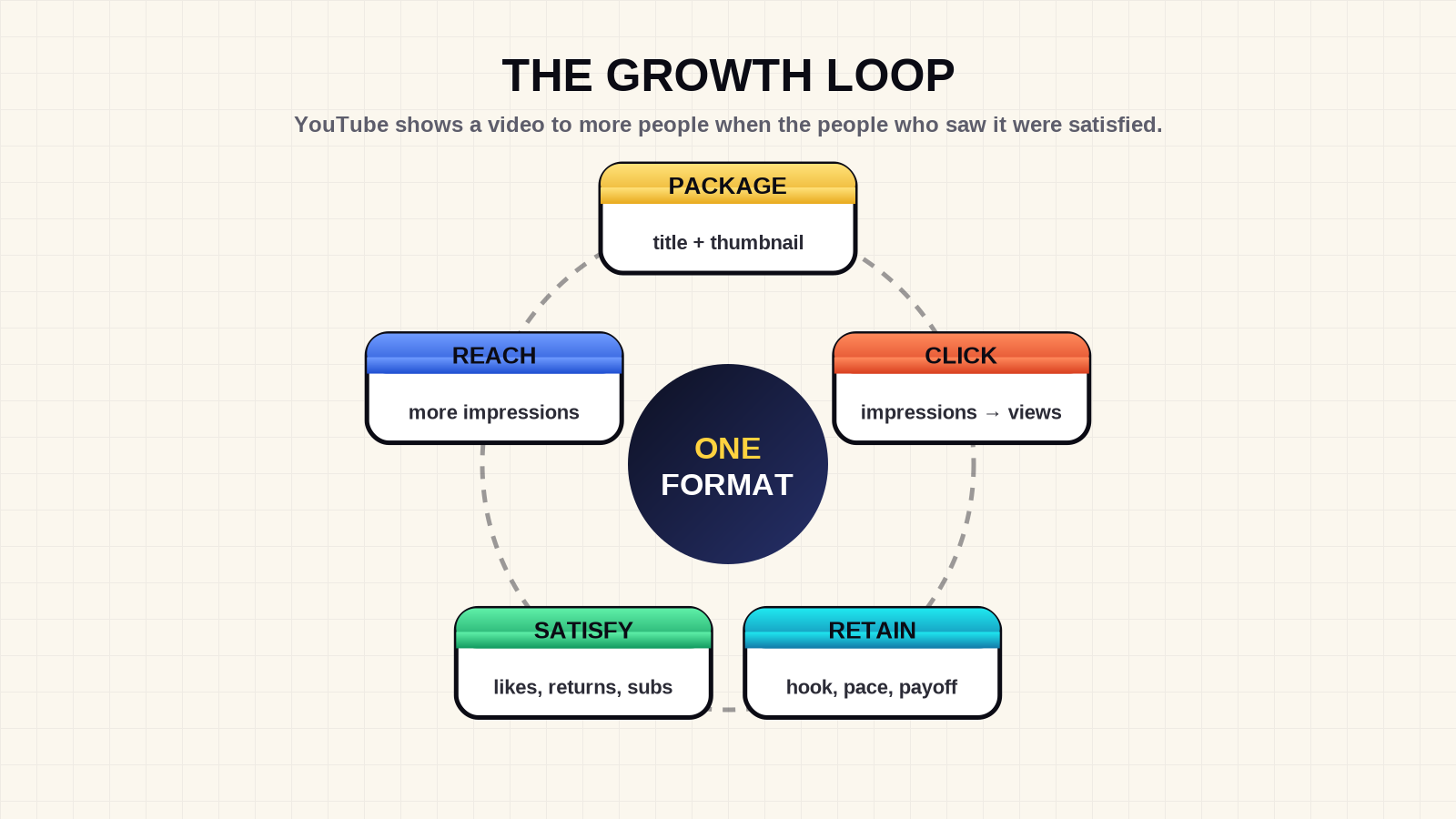
At zero subscribers, YouTube has no audience to show your video to yet, so it tests it with small groups of viewers who watch similar things. Your job is to make something those viewers already want.
- Find outliers, not big channels. Look for videos in your niche that got far more views than that channel normally gets. An outlier on a small channel tells you the idea worked, not the creator's fame.
- Collect the questions. YouTube's search suggestions, comments on outliers and keyword tools show what people actually type. A question with a short answer is a Short; a question with a story is a long video.
- Write the angle. Don't copy the outlier. Ask what it promised and how you could deliver that promise better, in your format.
Research tools (keyword explorers, outlier finders) save hours, but they only estimate demand. Treat their scores as hints and let your own published videos be the real test.
Package first, script second
The title and thumbnail decide whether anyone sees your script at all. Write them first, then write the video that delivers on them.
- One idea per package. The thumbnail shows the tension; the title adds what the image can't. Don't repeat the same words in both.
- Readable at phone size. Three words or fewer on the thumbnail, high contrast, one focal point.
- Honest. Clickbait that the video doesn't pay off drives people away early, and that hurts more than a lower click rate.
When you have a few videos out, use YouTube Studio's Test & Compare: it can test up to three titles and/or thumbnails on the same video and picks the winner by watch time share, not just clicks. That is the right metric, because a package that gets clicks but loses viewers isn't a winner.
Earn the retention
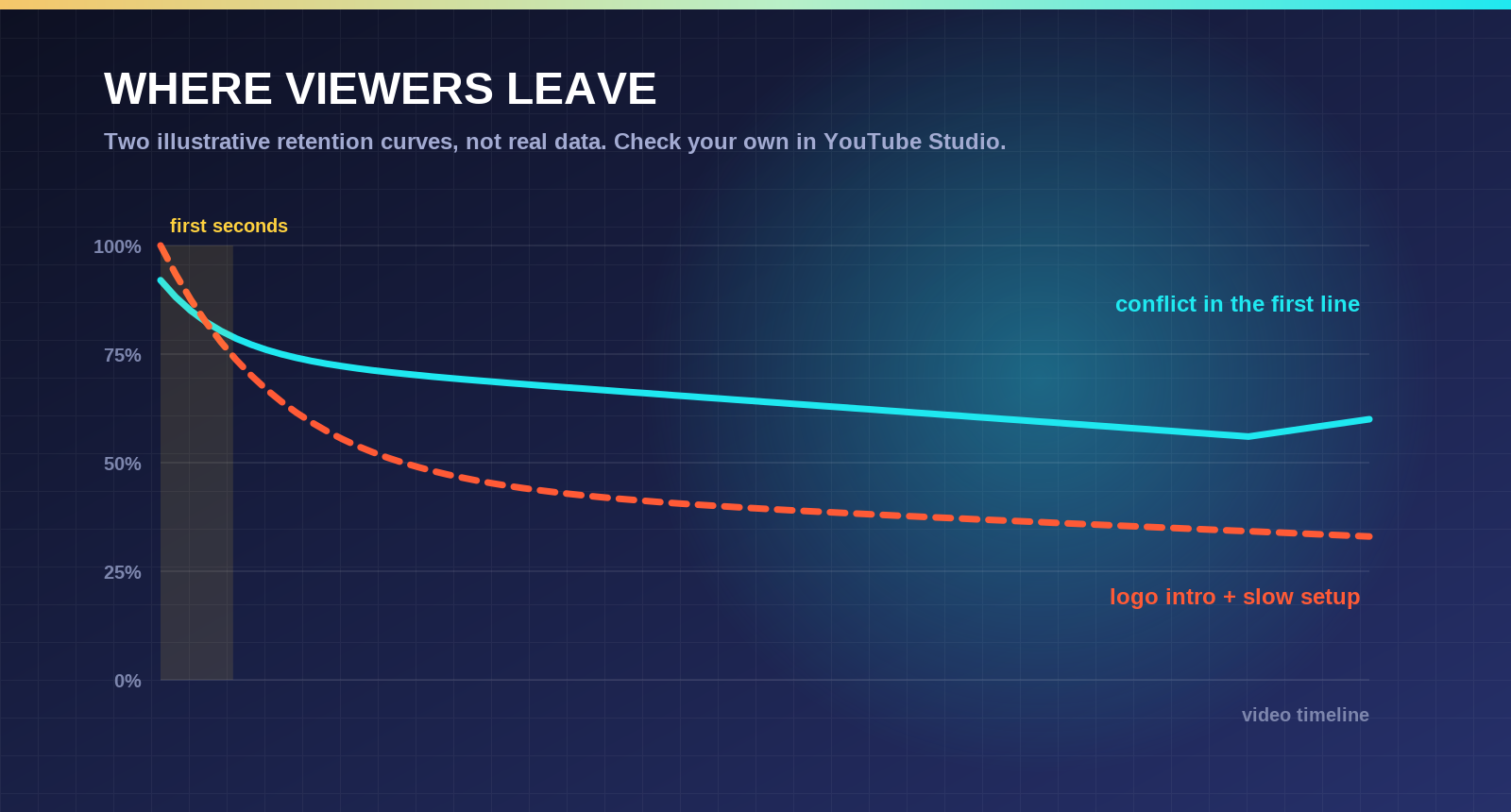
The first seconds matter most, because that's where the steepest drop happens. For a faceless channel, that means no logo intro, no "in this video we'll talk about", no slow zoom on a title card.
- Open on the conflict. Start with the most surprising line or the question the title promised to answer.
- Change something every few seconds. A cut, a new shot, a caption, a sound. Animation makes this cheap because you control every frame.
- Hold back the payoff. Set up the answer early and deliver it near the end, so viewers have a reason to stay.
- End cleanly. When the story is over, end the video. Long goodbyes lower average view duration.
Publish on a rhythm you can keep
Growth from zero is mostly a numbers game of honest experiments: each video tests one idea, one package and one hook. More tests means you find what works sooner. That's where production speed matters.
- Batch. Write five scripts in one sitting, produce them in the next, publish over the week.
- Automate the repetitive parts. Voices, captions, rendering and exports are the same every time. Ideas, packaging and the final review are not. Our guide to Claude AI YouTube automation shows how we split that work.
- Change one variable at a time. If you change the topic, the thumbnail style and the length in the same week, you won't know which one mattered.
Spend your hours on ideas, not on editing
The Starter is our faceless production setup: Claude Code writes, voices, animates and cloud-renders each episode, so you can test more ideas in the same week.
See the Starter kit, $19One-time payment. Requires Claude Pro ($20/month).
Read four numbers, ignore the rest
YouTube Studio shows dozens of metrics. At the start, four tell you almost everything:
| Metric | What it tells you | What to change if it's weak |
|---|---|---|
| Impressions click-through rate | Whether the package earns the click | Title and thumbnail |
| Average percentage viewed / retention graph | Whether the video keeps its promise | Hook, pacing, length |
| Returning viewers | Whether people come back for the format | Consistency of look, voice and series |
| Subscribers per video | Which videos make people want more | Make more of those |
Compare each video with your own channel median, not with other creators. "Twice my usual views" is a signal. "Less than a famous channel" isn't. For Shorts, also look at how many viewers chose to view versus swiped away. It's the Shorts version of the hook test.
A 90-day roadmap
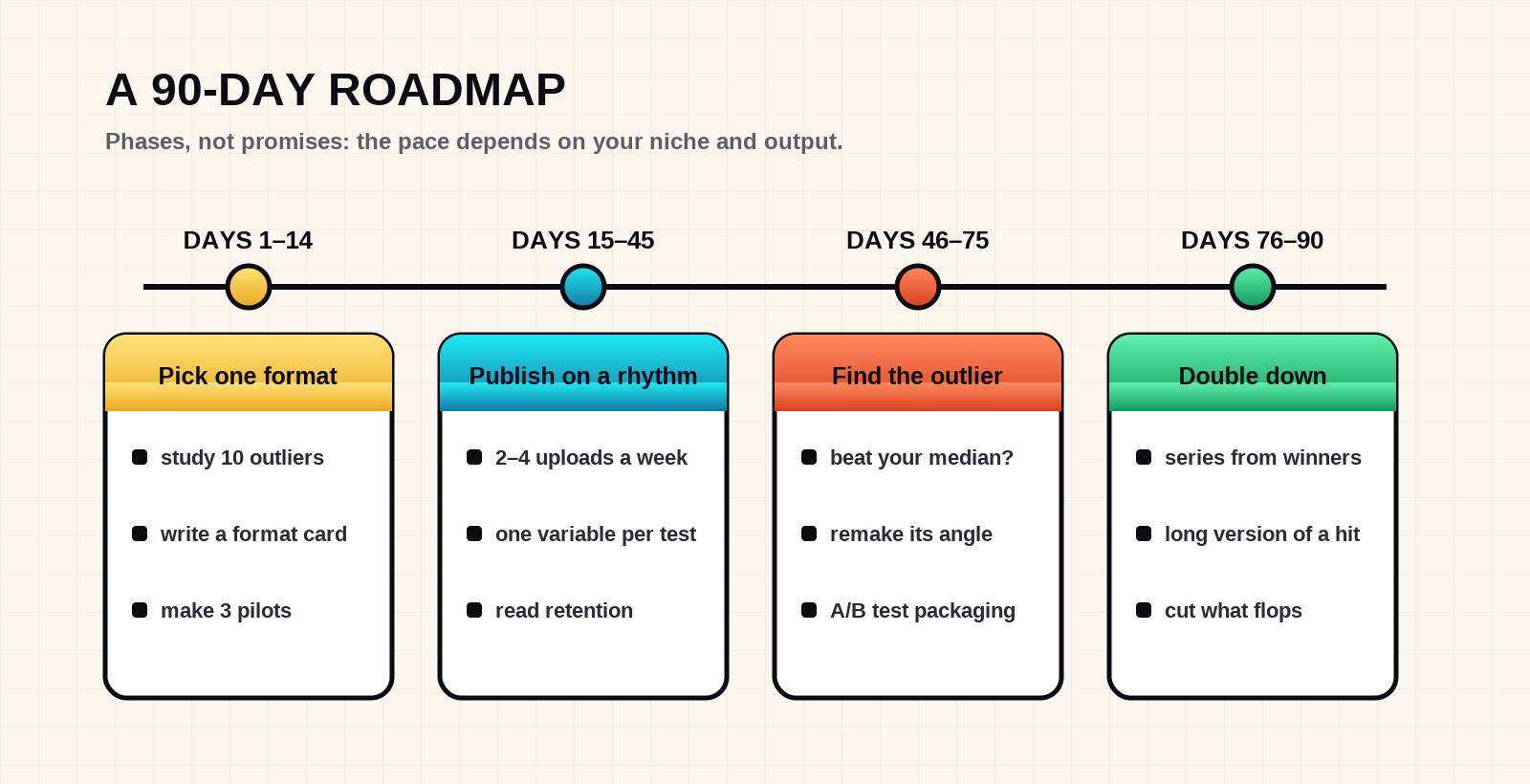
Days 1–14: pick one format
Study ten outliers in your niche, write the format card, and make three pilot videos. Don't publish the pilots yet. Watch them back to back: if they feel the same, you have a template, not a format.
Days 15–45: publish on a rhythm
Publish at a pace you can keep, two to four Shorts or one long video a week, for example. Keep a simple log: idea, title, thumbnail, hook line, and the four numbers after seven days.
Days 46–75: find the outlier
Look for the one or two videos that beat your median. Ask what was different: the topic, the angle, the first line, the thumbnail. Make three new videos that keep that difference and change something else. Start running Test & Compare on new uploads.
Days 76–90: double down
Turn winners into a series. Make a longer version of your best Short. Drop the ideas that flopped twice. At this point you might be close to the 500-subscriber tier; we explain what each tier unlocks in YouTube Shorts monetization in 2026.
Mistakes that keep faceless channels at zero
- Changing niche every two weeks. The audience never gets a chance to form.
- Templates disguised as a format. Same narration, same stock clips, different keyword. That's exactly what YouTube's inauthentic content policy targets.
- Buying views or subscribers. It breaks your data and can break your channel. Fake engagement violates YouTube's policies.
- Ignoring the first seconds. No package can save a video that loses everyone at the start.
- Never reviewing the video before it goes out. A wrong fact or a broken caption costs trust that a faceless channel can't afford.
One shortcut if you already post on other platforms: your own Reels and TikToks are tested ideas. Our free downloader saves your own clips without a watermark, so you can rework the ones that performed into Shorts instead of starting from a blank page.
FAQ
How long does it take to grow a YouTube channel from zero?
There's no reliable timeline. Some channels find a format that works in weeks, many take months, and some never do. What you can control is how many honest experiments you run: each video is a test of an idea, a package and a hook.
Can you grow on YouTube without showing your face?
Yes. Faceless channels grow through a recognizable format: a consistent look, a voice, a recurring cast or a signature structure. Animation, explainers and story channels are common faceless formats.
Should a new channel post Shorts or long videos?
Both can work. Shorts are cheap to test and good for discovery; long videos usually build deeper loyalty and pay more per view once monetized. Many channels test ideas as Shorts and turn the winners into longer videos.
How often should I upload to grow on YouTube?
As often as you can without lowering quality. A steady rhythm you can keep for three months beats a burst followed by silence. Two to four uploads a week is a common starting point for Shorts; long-form channels often do one.
Does YouTube punish channels that use AI?
YouTube doesn't ban AI tools, but its inauthentic content policy targets templated, mass-produced videos with little variation. Realistic synthetic content must be disclosed. Use AI to speed up production, not to replace the idea.
Make the next 30 videos easier than the first
Get the engine, the blueprint and the prompts we use to keep a faceless format consistent, and start your 90 days this week.
See the Starter kit, $19One-time payment. Requires Claude Pro ($20/month).